The introduction of ThoughtSpot Inc.'s new agentic analytics suite marks a crucial pivot point in the relentless, often exhausting, mechanics of business intelligence. This is a case study in technological empathy, recognizing that for too long, the analytical lifecycle has been defined by grueling construction rather than the simple, vital act of understanding.
As Francois Lopitaux, ThoughtSpot’s senior vice president of product management, noted, customers spend boundless energy building pipelines and models, neglecting the fundamental goal: insight. That burdensome, necessary grunt work—all those hours spent meticulously defining joins and schema—is precisely what these agents, conceived as semi-autonomous partners, aim to relieve.
What ThoughtSpot has provided isn't merely automation; it’s a delegation of the tedious middle steps.
They have tailored four distinct agents to speak directly to different personas, intending to offer what Lopitaux calls "a friend in the business." SpotterModel, for the data engineer, is perhaps the most fundamental shift. It ingests natural-language instructions and proposes complex semantic modeling, suggesting tables and logic where the human once had to forge every connection by hand.
The brilliance here is the built-in humility: the agent suggests, but the expert validates. There is a strong, intentional component of the human in the loop, ensuring that these autonomous capabilities serve as advisors, not replacements. The expertise of the human professional remains essential.
The agents extend into the visualization layer and beyond.
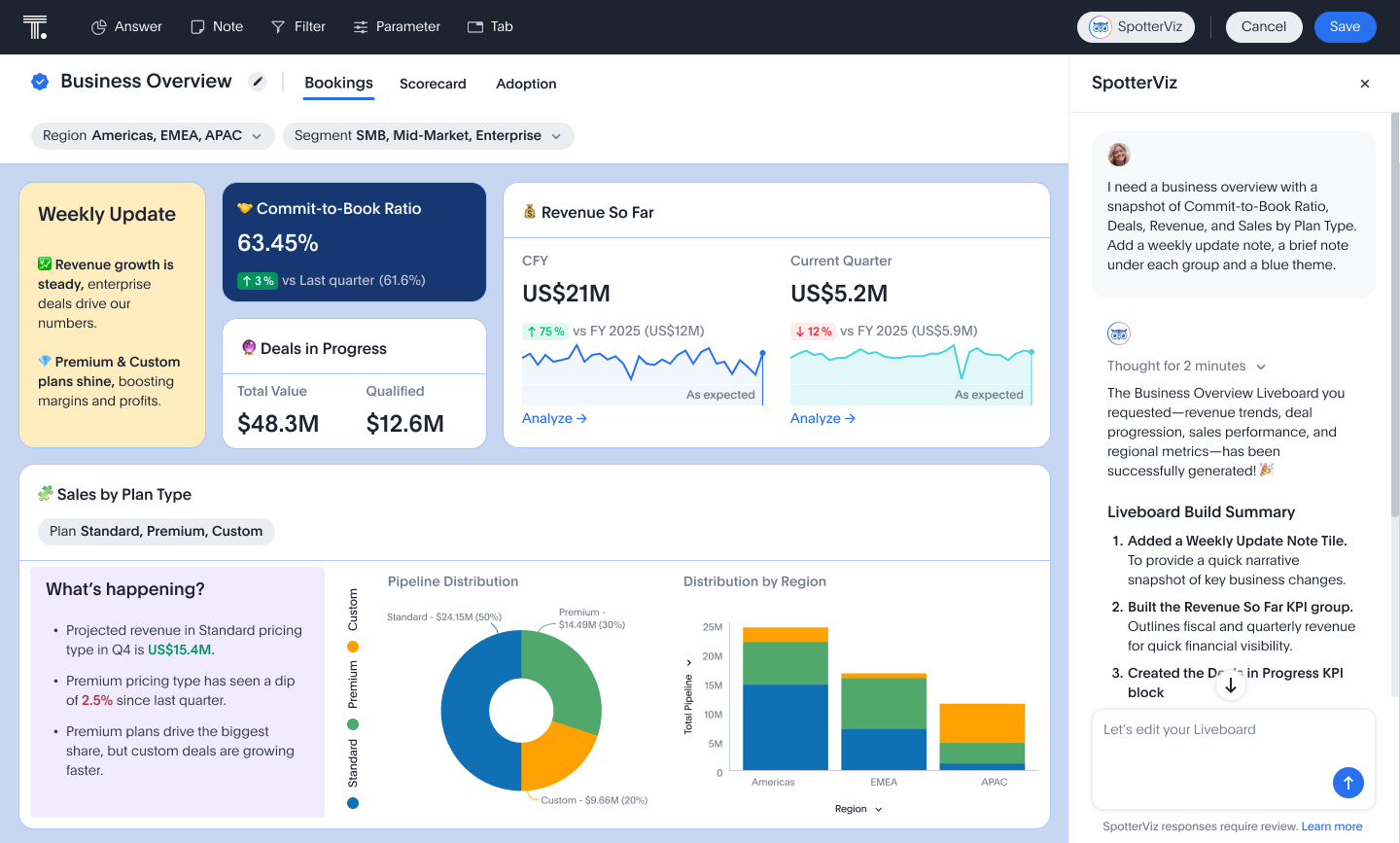
SpotterViz addresses the persistent reality of organizational analytics—the dashboard. Even as ThoughtSpot champions moving past reliance on static visualizations, the dashboard endures, a fixture in most operations. SpotterViz automates the often-fiddly creation process, managing layout, design, and KPI selection, making that transition easier, lighter. But the true north remains Spotter 3, the engine at the core.
This agentic analyst empowers users to bypass the structured query languages and the heavy lifting of traditional BI tools altogether. Just the analytical question, asked plainly. And the answer, immediate.
• SpotterModel Simplifies semantic modeling by proposing tables, logic, and joins based on natural-language inputs, requiring human validation before implementation.• SpotterViz Automates the creation of dashboards, streamlining layout, design choices, and the selection of key performance indicators.
• SpotterCode Supports embedded development, accelerating the process for developers who integrate analytical features into other applications.
• Spotter 3 Functions as the primary agentic analyst, allowing users to pose complex analytical questions and receive direct, real-time answers without requiring traditional dashboards or SQL coding.
The landscape of business intelligence is undergoing a profound transformation, one that's as much about the human experience as it is about technological advancement. At its core, business intelligence is about making sense of data, about extracting insights that can inform decision-making and drive growth. And yet, as we find ourselves at the intersection of data, analytics, and artificial intelligence, it's clear that the tools we use are only as powerful as the stories we tell with them.
According to SiliconANGLE, the convergence of BI and AI is giving rise to a new generation of platforms that can learn, adapt, and even predict.
These emerging technologies are not just incremental improvements; they're fundamentally changing the way we approach data analysis. With the help of machine learning algorithms and natural language processing, businesses can now uncover patterns and trends that would have gone undetected just a few years ago.
For instance, advanced analytics tools can sift through vast amounts of customer data to identify subtle correlations and causations, allowing companies to tailor their marketing efforts with unprecedented precision.
As SiliconANGLE reports, this fusion of human intuition and machine intelligence is yielding remarkable results, from enhanced customer experiences to data-driven innovation. As we look to the future, it's clear that the boundaries between business intelligence, data science, and AI will continue to blur.
Looking to read more like this: See hereThoughtSpot Inc. today introduced a suite of business intelligence agents designed to automate major components of the analytics workflow, spanning ...◌◌◌ ◌ ◌◌◌