
As the pandemic causes an increase in online purchasing activity, ecommerce platforms are collapsing in droves, unable to keep up with the expanding volume of visitors and transactions.
While this may sound like a good problem to have, it's completely preventable. Yet companies are continuing to release platforms without accounting for an increase in users, which will cause long-term issues in customer experience and service delivery.
Other things to check out:
Retailers: Is Your E-Commerce Website Ready For A Sales Surge?

Chances are e-commerce sales will continue to climb as consumers wary of Covid-19 increasingly turn to the web to make purchases rather than shop in-store. But that means retailers and e-tailers need to make sure their e-commerce sites are in tip-top shape.
As more consumers shop online during the coronavirus pandemic, retailers need to ensure their ... [+] e-commerce sites are in tip-top shape.
Rieva Lesonsky: What do small retailers need to know about building a solid e-commerce website?
New Partnership Offers Flexible, Powerful Ecommerce to Provide the Best Experiences for Customers

Coveo and commercetools team up to provide unified multi-channel and intelligent Ecommerce architecture for highly personalized buyer experience
From consumer brands to B2B manufacturers, from retailers to wholesalers, all have had to become more nimble to keep up with shopper and buyer expectations. Unfortunately, global Ecommerce companies who jumped on the web a decade or more ago have been stuck with a code-heavy infrastructure that lacks flexibility. Those companies still encumbered with aging legacy application suites have been seeking ways to evolve their Ecommerce capabilities.

Auto Parts eCommerce Market Share Exceeding Original Forecast by Nearly $2 Billion
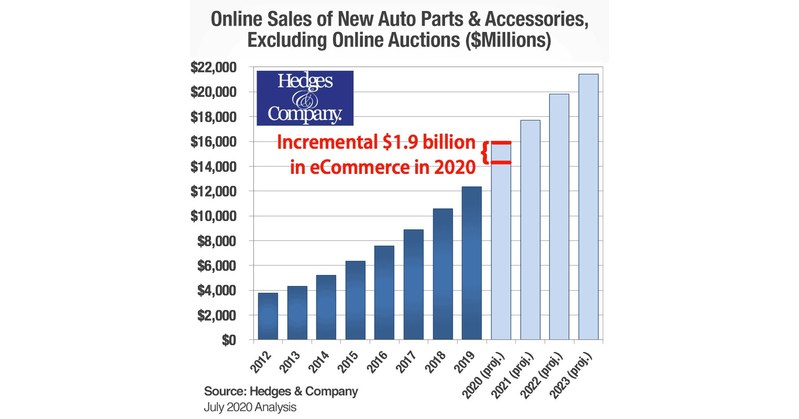
HUDSON, Ohio , Aug. 10, 2020 /PRNewswire/ -- The 13 th annual Hedges & Company eCommerce market share forecast for the US automotive aftermarket shows online revenue reaching $16 billion in 2020. This includes an incremental $1.9 billion in revenue due to the COVID-19 pandemic. A major trend during the pandemic, in nearly any industry, has been a dramatic shift to eCommerce market share.
* * *
This year's new forecast projects new auto parts and accessories eCommerce revenue at over $22 billion by 2023.
Many things are taking place:
Lessons from 20 years of ecommerce | Practical Ecommerce

My first ecommerce site was a supplement to my brick-and-mortar shop in 2000. There was little online competition. Amazon sold only books. Most of my competitors were small independents like me, and it was easy to stand above the crowd. I advertised the site on shopping bags, on leaflets at conventions, and in an occasional magazine.
This post is the second in a series on starting and growing an ecommerce business. The first installment, “ Launching an ecommerce business: the first steps ,” I published last month.

Facebook Financial Ramps Up eCommerce Efforts | PYMNTS.com

Facebook has accelerated up its eCommerce expansion efforts even as the COVID-19 pandemic has boosted online shopping.
Now, it is launching a new group within the company, Facebook Financial, that will pursue payments and eCommerce opportunities, Bloomberg News reported . The new group will be in charge of all the company's payments projects — including Facebook Pay, its payments offering that is planned for all of its apps.
Industrial real estate demand surges amid pandemic e-commerce boom | Fox Business

ZipRecruiter Labor Economist Julia Pollak on where the jobs are in America and which sectors are struggling.
Demand for industrial real estate is surging as the coronavirus pandemic causes businesses to rely on e-commerce and domestically manufactured products to accelerate supply-chain efficiencies.
* * *
E-commerce shifted into high gear in April when nonessential stores shut down in order to mitigate the spread of the novel coronavirus, prompting a greater need for warehouses to store products and plants to make goods. More retailers are pivoting to e-commerce and revisiting supply chains in order to fight for survival while brick-and-mortar retail remains stagnant. And now, retailers are even more reliant on fulfillment centers and warehouse facilities for their e-commerce operations.
Global Ecommerce 2020 Report - Business Insider
Ecommerce has been a bright spot among retail channels during the coronavirus, as consumers became reliant on digital transactions amid physical store closures and fear of infection. However, the impact on ecommerce retail spending has not been felt evenly across the world.
Asia-Pacific and North America have led the regional totals for both brick-and-mortar and ecommerce sales, followed by Western Europe. Due in part to China's dominance, Asia-Pacific has gained a significant lead in ecommerce with 62.6% share, over North America and Western Europe, who are expected to have shares of 19.1% and 12.7%, respectively.

No comments:
Post a Comment