Martha, who sold beautifully constructed ceramic mugs, often sat at her kitchen table long after the streetlights came on, staring at the ad metrics. The anxiety of seeing perfectly good money vanish into the Facebook machine—the inconsistent returns—felt deeply personal. She wasn’t looking for spectacular growth, only *stability*. It seems many entrepreneurs feel this particular strain; the dread of the unsustainable quick win, followed by the inevitable crash.
Peter Szabo’s AICommerce offers a careful, reasoned solution to that specific midnight worry.
The Architecture of Predictability
AICommerce posits a challenge to this common anxiety. Peter Szabo built the company on the premise that stability in e-commerce marketing is achievable, but it requires architecture.
Traditional agencies often treat ad campaigns like a disorganized experiment—tossing a wide net and hoping for luck. This approach, often characterized by inconsistent “trial-and-error,” is a critical failure point for long-term growth.
AICommerce exchanges speculation for structure. By blending machine learning tools with disciplined human strategy, the agency constructs Facebook ad campaigns designed not for fleeting virality, but for consistent conversion and predictable scalability.
Every campaign adheres to a defined, systematic process intended to reduce unnecessary expenditure. This strategic framework allows e-commerce brands to grow predictably across various markets, offering a clear alternative to marketing partnerships that rely on guesswork instead of evidence. The core belief is simple: campaign control eliminates wasteful spending.
Psychology Before Strategy
But the true singularity of this approach rests not only in the algorithms, but in the human factor.
Szabo holds the philosophy that “80% of business success is psychology, and 20% is strategy.” This is an unusual admission for a digital marketing firm. Running an online business is often a solitary, emotionally taxing endeavor, demanding high focus and emotional resilience from the owner.
The agency integrates personalized psychological coaching directly into its marketing structure.
Every client gains access to guidance intended to strengthen decision-making and reduce the internal friction that often impedes clear business choices. By addressing the owner’s mindset as part of the marketing infrastructure, AICommerce suggests an acute understanding of what makes a small business truly scalable.
The system is designed to help remove the internal obstacles before addressing the external ones.
Measured Performance, Not Hope
The technical execution supports this disciplined outlook. Campaign adjustments are continuous and evidence-based. Using analytics, creative strategy, and robust machine learning, the agency adjusts ads in real-time based on measurable performance, making sure each campaign evolves efficiently.
Their integrated services prioritize deep conversion tracking and rigorous audience testing. The testing cycles are not random experiments; they are designed to ensure the right messages reach the right customers, consistently improving engagement and profitability.
Transparency is non-negotiable within this model.
Clients receive clear reporting, ensuring they understand precisely how each advertising decision impacts their growth trajectory. This clarity is a necessary component of trust. It contrasts sharply with marketing operations that obscure metrics, prioritizing activity over accountable results. AICommerce focuses on delivering results that feel stable and controllable, allowing the entrepreneur, like Martha, to finally find peace at the kitchen table.
• Systematic Structure Campaigns prioritize predictable, stable systems over inconsistent, high-risk strategies.• Integrated Psychology Clients receive personalized coaching to improve focus and decision-making, recognizing that the owner's mindset is 80% of business success.
• Waste Reduction Continuous real-time adjustments and rigorous testing cycles are designed to minimize wasted ad spend and maximize return.
• Transparent Reporting Clear metrics ensure clients maintain comprehensive understanding and control over their growth trajectory.
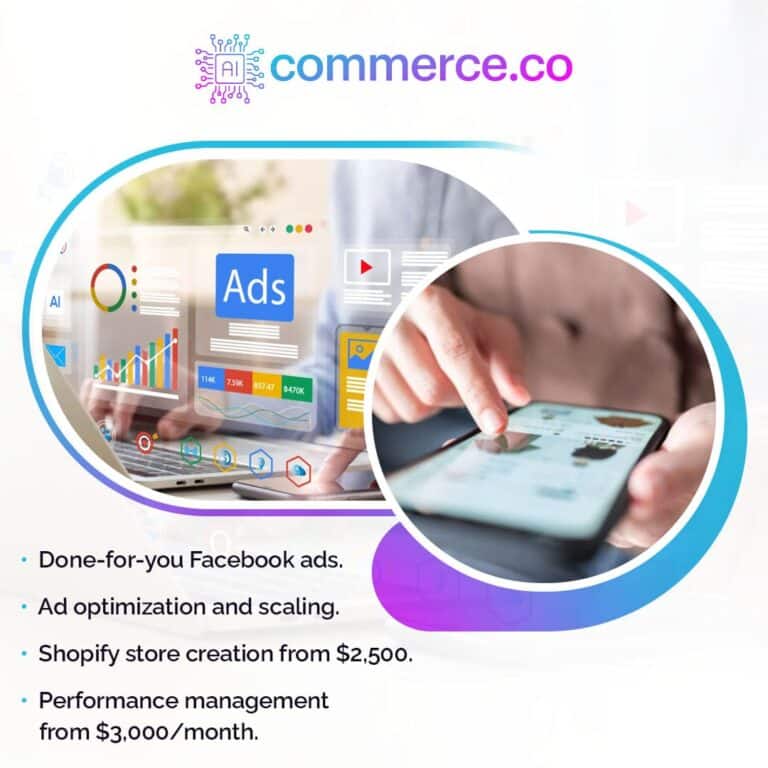
In the vast expanse of digital commerce, businesses are constantly seeking innovative ways to reach their target audience. A well-crafted ecommerce marketing strategy is essential for driving sales, increasing brand awareness, and staying ahead of the competition. This involves a deep understanding of consumer behavior, market trends, and the ever-evolving landscape of online shopping.
Effective ecommerce marketing solutions require a multi-faceted approach, incorporating elements such as search engine optimization, social media marketing, email marketing, and influencer partnerships.
By leveraging these channels, businesses can create a cohesive brand narrative that resonates with their target audience and drives conversions.
For instance, a company may utilize data analytics to identify key demographics and tailor their marketing efforts accordingly, resulting in a significant increase in sales and customer engagement.
According to a recent report in The Detroit Free Press, companies that invest in ecommerce marketing solutions are seeing significant returns on their investment.
By adopting a data-driven approach and staying agile in a rapidly changing market, businesses can position themselves for long-term success and establish a strong online presence.
As the ecommerce landscape continues to evolve, it's clear that a robust marketing strategy is no longer a luxury, but a necessity for businesses looking to thrive in the digital age.
Alternative viewpoints and findings: Visit websiteAICommerce , founded by Peter Szabo, offers a smarter approach to e-commerce marketing by combining AI tools, expert strategy, and structured ...●●● ●●●

No comments:
Post a Comment